If you’re searching for practical guidance on navigating the wild with confidence, this guide delivers exactly that. Whether you want to master hidden forest routes, sharpen your wilderness survival tactics, or build reliable camp setup skills, you’ll find clear, field-tested direction here.
Outdoor exploration is rewarding—but it can quickly turn risky without the right knowledge. Many adventurers struggle with reading terrain, mapping trails accurately, or preparing camps that withstand shifting weather conditions. This article breaks down essential trail mapping strategies, core outdoor skills, and survival fundamentals in a way that’s straightforward and actionable.
Our insights are grounded in hands-on field experience, cross-checked against proven backcountry safety practices and real-world navigation scenarios. You’ll learn how to identify safe passageways, prepare for unexpected conditions, and move through forest landscapes with purpose and awareness.
By the end, you’ll have a practical framework to explore smarter, travel safer, and approach every horizon with confidence.
Finding peace in nature shouldn’t mean circling a packed trailhead or queuing for summit photos. Yet that’s the reality at many flagship parks. So what’s the alternative?
This guide solves that problem by showing you how to move beyond overused paths and into truly secluded terrain. Drawing on hard-won experience in wilderness navigation and off-trail travel, it offers a safety-first framework competitors rarely detail: layered map analysis, terrain traps to avoid, seasonal access windows, and discreet scouting of hidden forest routes.
In short, you’ll learn how to plan, navigate, and return safely—without the crowds. Preparation is your ultimate advantage here.
Digital Trailblazing: How to Unearth Hidden Trails
Mainstream hiking apps are convenient—but they’re also crowded. Platforms like AllTrails rely heavily on user submissions, which means the most visible routes attract even more traffic (the Instagram effect in action). As a result, quieter paths get overlooked, and fragile ecosystems take the hit. If you’re searching for hidden forest routes, you’ll need to move beyond the usual feeds and star ratings.
Mastering Topographical Layers
Start with digital mapping tools like Gaia GPS or CalTopo. A topographical map shows elevation changes using contour lines—tight lines mean steep terrain, wide spacing signals gradual slopes. Look for faint dashed lines (often old service roads or unofficial trails). Additionally, scan for saddle points (low areas between peaks) and ridgelines, which frequently host footpaths. Old logging grids can also reveal forgotten access corridors. Pro tip: toggle between public land overlays and slope shading to avoid trespassing or impassable inclines.
The Power of Satellite Reconnaissance
Next, open Google Earth. Zoom in and switch to satellite view. Look for subtle clearings, worn parking pull‑offs, or narrow breaks in tree canopy—these often indicate informal trailheads. Then, trace lighter lines through vegetation; repeated foot traffic creates faint but visible scars. Use the historical imagery slider to confirm whether a path persists over time (seasonal washes can be misleading).
Tapping Local Sources
Finally, check county and state forest websites for lesser-known trail maps. Better yet, call a ranger station and ask about low-traffic areas. Niche hiking forums and regional outdoor clubs also share vetted suggestions—often with context about seasonal hazards or access quirks. In short, combining digital tools with local insight turns guesswork into strategy.
Gearing Up for the Unknown: Essential Kit for Secluded Hikes
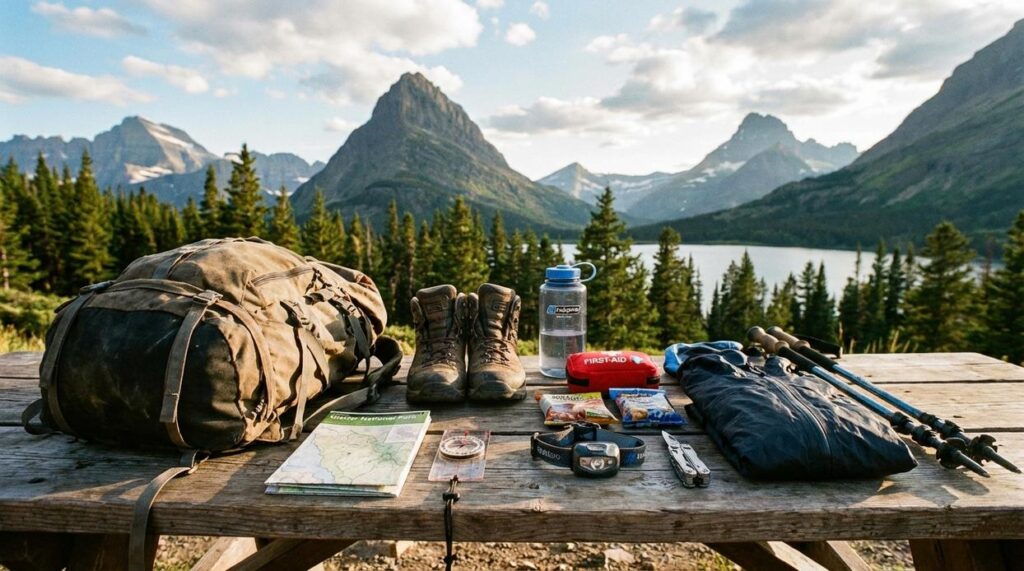
When you’re miles from the nearest trailhead, self-reliance isn’t romantic—it’s mandatory. Think less “weekend warrior” and more The Revenant (but ideally with a better ending).
The Redundancy Rule for Navigation
First and foremost, follow the Redundancy Rule: always carry both a digital GPS device and a physical map and compass. Redundancy means having backup systems in case one fails. Batteries die. Screens crack. Signals vanish. However, paper doesn’t run out of power, and a compass won’t freeze mid-update.
Some argue smartphones are enough. After all, mapping apps are incredibly advanced. That’s true—until you lose service or drop your phone in a creek (which happens more often than people admit). Knowing how to triangulate your position with a compass isn’t old-school—it’s survival.
Upgrading Your “10 Essentials” for Solitude
Next, upgrade your classic 10 Essentials—the standard safety gear every hiker should carry. In remote areas, these become non-negotiable.
- Communication: A Personal Locator Beacon (PLB)—a satellite distress device that sends your exact coordinates to rescue services—can be life-saving. No bars required.
- First Aid: Pack supplies for major injuries, not just blisters. Include compression bandages and wound care for deep cuts.
- Power: Bring a fully charged battery bank. Even your backup needs a backup. (Yes, it’s that serious.)
Footwear and Clothing for Rough Terrain
Finally, prepare for unmaintained paths and hidden forest routes. Durable, waterproof boots with ankle support protect against uneven ground. Layered clothing—base, insulating, and shell layers—helps regulate temperature as conditions shift unexpectedly.
If you’re exploring destinations like these underrated national parks for solitude seekers, preparation is the difference between adventure and emergency.
Because out there, you are the rescue plan.
Practical navigation starts with a topographic map. A topographic map shows elevation through contour lines—thin brown lines that connect equal heights. When those lines sit close together, the terrain is steep; when they’re spaced wide, the ground is gentler. Think of them like stacked pancakes: tighter stacks, sharper climbs. To take a bearing, place your compass flat, point the direction-of-travel arrow toward your landmark, then rotate the housing until the needle sits inside the orienting arrow. Read the degree mark, and follow that line across the map. Pro tip: practice before you rely on it.
Next, file a non-negotiable trip plan. Include your exact route, potential alternates, vehicle description and plate, gear list, and start and return times. Leave it with someone reliable, and set a clear “call for help” deadline. Some hikers argue this feels excessive for short outings. However, search teams move faster with specifics, especially in hidden forest routes.
Meanwhile, wildlife in quiet areas may act less habituated to humans. Bears might defend space; moose can charge if startled. If you encounter a bear, stop, speak calmly, back away slowly, and avoid eye contact. For moose, put terrain between you and the animal and retreat.
Finally, adopt S.T.O.P.—Stop, Think, Observe, Plan. If disoriented, pause, control breathing, assess landmarks, then decide your next move. What’s next? Practice these skills locally, upgrade to night navigation, and review weather patterns before longer treks. Preparation compounds, like interest, over time. Confidence follows competence, and competence follows consistent repetition. Start small today.
Embrace the Quiet: Your Next Adventure Awaits
Crowded trails aren’t just annoying—they dilute the very thing you went outside to find: calm. In other words, solitude (intentional time alone in nature) is hard to experience when the parking lot is full and the switchbacks feel like a line at a theme park. However, the solution isn’t obsessively hunting for secret spots. It’s building skills.
Once you understand trail mapping (reading topographic lines to gauge elevation), proper layering (wearing moisture-wicking and insulating fabrics), and basic navigation (using a map and compass or GPS), you unlock access to hidden forest routes that others overlook. Consequently, preparation becomes your competitive edge.
Some argue that popular trails are safer—and yes, they can be. Yet safety comes from competence, not crowds.
Now you have the tools. So start small. Research a nearby state forest, identify a designated but lesser-used trail, and plan a short exploratory hike. Step by step, quiet returns.
Master the Wild With Confidence
You set out to learn how to navigate tougher terrain, sharpen your outdoor instincts, and explore with greater confidence. Now you have the practical trail mapping strategies, camp setup essentials, and wilderness survival tactics to move beyond guesswork and into real capability.
The biggest frustration in the wild isn’t the weather or the miles ahead — it’s uncertainty. Second-guessing your route. Worrying your camp won’t hold. Missing hidden forest routes that could transform your entire journey. Those pain points fade when you’re equipped with the right knowledge and preparation.
Here’s your next move: put these skills into action. Plan a route, test your mapping techniques, refine your camp setup, and deliberately practice one new survival skill on your next outing. Mastery comes from repetition.
If you’re serious about becoming self-reliant outdoors, don’t stop here. Join thousands of outdoor enthusiasts who rely on our field-tested guidance to sharpen their edge and explore smarter. Dive deeper, train harder, and start your next adventure prepared — not guessing.