If you’re searching for practical guidance on mastering the outdoors, you’re in the right place. Whether you want to sharpen your trail mapping abilities, strengthen your wilderness survival tactics, or build confidence setting up camp in unpredictable conditions, this article is designed to give you clear, field-tested direction.
Outdoor skills aren’t learned through theory alone—they’re built through proven techniques, careful planning, and an understanding of real-world conditions. Here, we break down essential strategies step by step, including route planning, terrain assessment, shelter selection, and compass navigation skills that keep you oriented when technology fails.
Our insights are grounded in established survival principles, widely practiced backcountry methods, and guidance drawn from experienced outdoor professionals. The goal is simple: equip you with reliable, actionable knowledge you can apply immediately on the trail. By the end, you’ll have a stronger foundation in core outdoor skills and the confidence to handle your next adventure safely and effectively.
Mastering the Timeless Art of Direction
In a world ruled by satellites, a magnetic compass is self-reliance. When batteries die or signals vanish, you need certainty—not hope. Critics argue GPS is faster and more accurate. True. But technology fails (usually at the worst moment). A compass does not.
To build confidence, practice before you need it:
- Learn to take a bearing and follow it.
- Orient a map to true north.
- Track back using landmarks.
Pro tip: rehearse in a park before heading wilderness.
Choose to use compass navigation skills as your primary method, not backup. Mastery turns panic into plan.
Anatomy of a Baseplate Compass
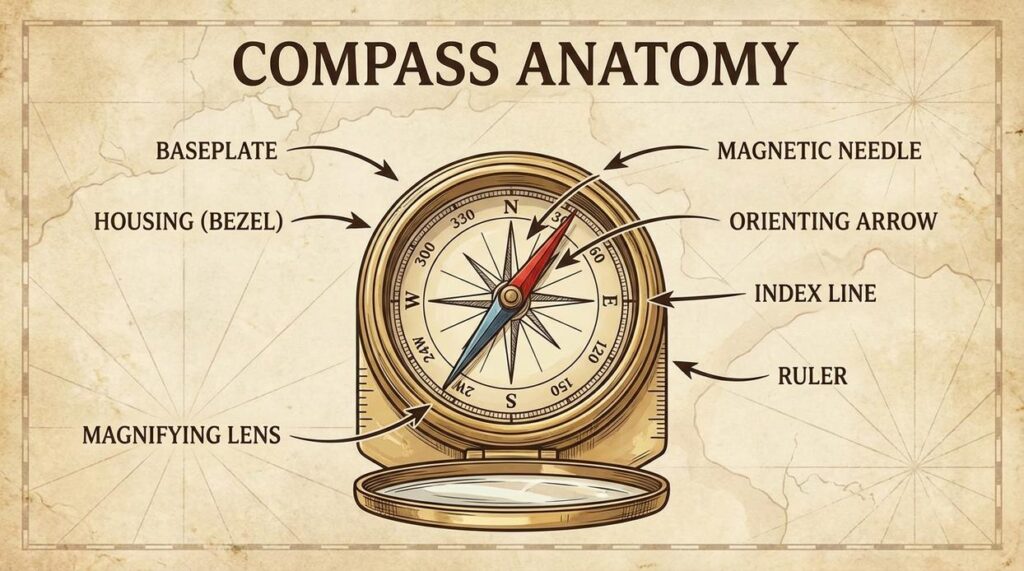
Understanding each part of your baseplate compass turns a confusing tool into a reliable trail partner. Let’s break it down practically.
The Essential Components in Action
The Baseplate is the clear foundation you hold. Because it’s transparent, you can place it directly over a map to see terrain beneath. The ruler along its edge helps you measure distance, while the Direction of Travel Arrow shows exactly where to point your body once you’ve set a bearing.
Next, the Bezel—the rotating 360-degree ring (also called the azimuth ring). Turn it to set your desired direction. For example, if your map shows a 70° bearing to camp, rotate the bezel until 70° lines up with the index mark.
Now, the Magnetic Needle does the real work. The red end always points to magnetic north (not true north—there’s a difference called declination).
To stay accurate, align the needle with the Orienting Arrow—a step often called “putting red in the shed.” Finally, use the Meridian Lines to match map grid lines before you start walking.
Before you can go anywhere, you need to know which way is which. Orienting yourself is the foundational skill. And yet, this is where most beginners get frustrated. The needle won’t settle. Your phone throws it off. You start doubting everything.
First, hold the compass flat and level in the palm of your hand, away from any metal objects like belt buckles or phones that cause interference. Then watch as the red magnetic needle slows and settles, pointing toward magnetic north. Next, rotate the bezel until the large orienting arrow sits beneath the red needle. This is called boxing the needle or putting red in the shed. Now the N aligns with north, and you’re oriented.
Simple, right? In theory. In practice, shaky hands and impatience ruin it. Still, mastering compass navigation skills builds confidence. Pro tip: pause, breathe, and let the needle finish moving before you touch the bezel.
Shooting a Bearing: How to Plot a Course to a Landmark
A bearing is a direction measured in degrees from north (0° to 360°). Think of it as a numeric way to say, “Head that way.” If you’ve ever followed a pirate map in a movie, you’ve seen the concept in action—just with more dramatic music.
Here’s my recommendation: practice this skill before you need it. Batteries die. Signals fade. And as we explain in understanding gps limitations in remote areas, technology has blind spots (especially when mountains get involved).
Step-by-Step: Taking a Bearing
- Choose a distinct, unmoving landmark—a peak, tower, or lone tree.
- Hold your compass flat and point the Direction of Travel Arrow directly at the landmark.
- Rotate the bezel until the orienting arrow lines up with the magnetic needle—”red in the shed.”
- Read the number at the index line. That’s your bearing.
For example, if it reads 270°, your landmark lies due west.
This is one of the most fundamental compass navigation skills you can build. Some argue GPS makes it unnecessary. I disagree. When visibility drops or electronics fail, this analog method keeps you oriented.
Pro tip: Take a bearing, walk 20–30 steps, then confirm it again. Small alignment errors grow fast (nature doesn’t correct your math).
Walking the Line with Confidence
Precision in the field isn’t about moving fast; it’s about moving deliberately. Once you’ve set your bearing—say 270 degrees—commit to it fully. Hold the compass flat, Direction of Travel Arrow pointing forward, and rotate your entire body until the magnetic needle settles inside the orienting arrow (“red in the shed”). Now your path is true.
Here’s my recommendation: don’t shuffle forward while staring down. Instead, lift your eyes and pick a distinct landmark—a jagged rock, a lone pine, a bend in the terrain. Walk to it. Then repeat. This “leapfrogging” technique keeps you on a straight line without having to stare at your compass constantly.
Some argue you should check your compass every few steps to avoid drift. Fair point. But over-checking slows you down and increases second-guessing (and yes, that’s how people start walking in nervous zigzags). Trust the process.
- Choose landmarks that are unmistakable and directly on your line, not “close enough.”
Think of it like following a lightsaber beam—straight, unwavering, intentional. Small corrections beat big recoveries.
Pro tip: in dense terrain, shorten your leapfrogging distance to maintain tighter accuracy without sacrificing momentum.
True north and magnetic north are not the same, and ignoring that gap can send you miles off course. Declination—the angular difference between magnetic north and true north—changes by location and is printed on quality topo maps. My recommendation: CHECK THE LEGEND EVERY TIME before plotting a route.
The rule is simple: add for westerly declination, subtract for easterly. Do it consistently.
- Confirm local declination
- Adjust your bearing
- Recheck before hiking
Use compass navigation skills to verify your heading in the field. Even skeptics who “eyeball it” admit precision prevents painful backtracking.
TRUST ACCURACY OVER GUESSWORK ALWAYS.
Confidence in the wild comes from competence, not luck. You now have the core skills to navigate with a compass: orienting yourself, taking a bearing, and following it accurately. By practicing regularly, you turn knowledge into instinct (and instinct keeps panic in check). TRUE MASTERY requires repetition in low-stakes environments like parks or familiar trails. Pick landmarks, confirm bearings, adjust for terrain, and track your progress.
Use compass navigation skills in the section once exactly as it is given
Build muscle memory so your hands move automatically when visibility drops. Small drills today prevent big mistakes tomorrow. Stay SHARP ALWAYS.
Master Your Next Adventure with Confidence
You set out to strengthen your outdoor abilities, sharpen your survival awareness, and feel fully prepared before stepping onto the trail. Now you have the core principles, practical tactics, and field-tested strategies to move through the wilderness with clarity instead of doubt.
When you’re deep in unfamiliar terrain, uncertainty is your biggest threat. A wrong turn, poor camp placement, or weak route planning can quickly turn a great trip into a stressful situation. That’s why refining your compass navigation skills, trail mapping approach, and camp setup decisions isn’t optional—it’s essential.
The right action now is simple: practice what you’ve learned before your next outing. Review your route, rehearse your navigation process, and test your setup in controlled conditions. Preparation builds instinct. Instinct builds safety.
If you’re serious about eliminating guesswork and becoming fully self-reliant outdoors, tap into the trusted, top-rated wilderness resources thousands rely on to train smarter and explore farther. Start sharpening your skills today—because confidence in the wild begins with preparation.